Second Paper – Krill Benthic Feeding, Individual Movement with Aggregation Density, Stuff

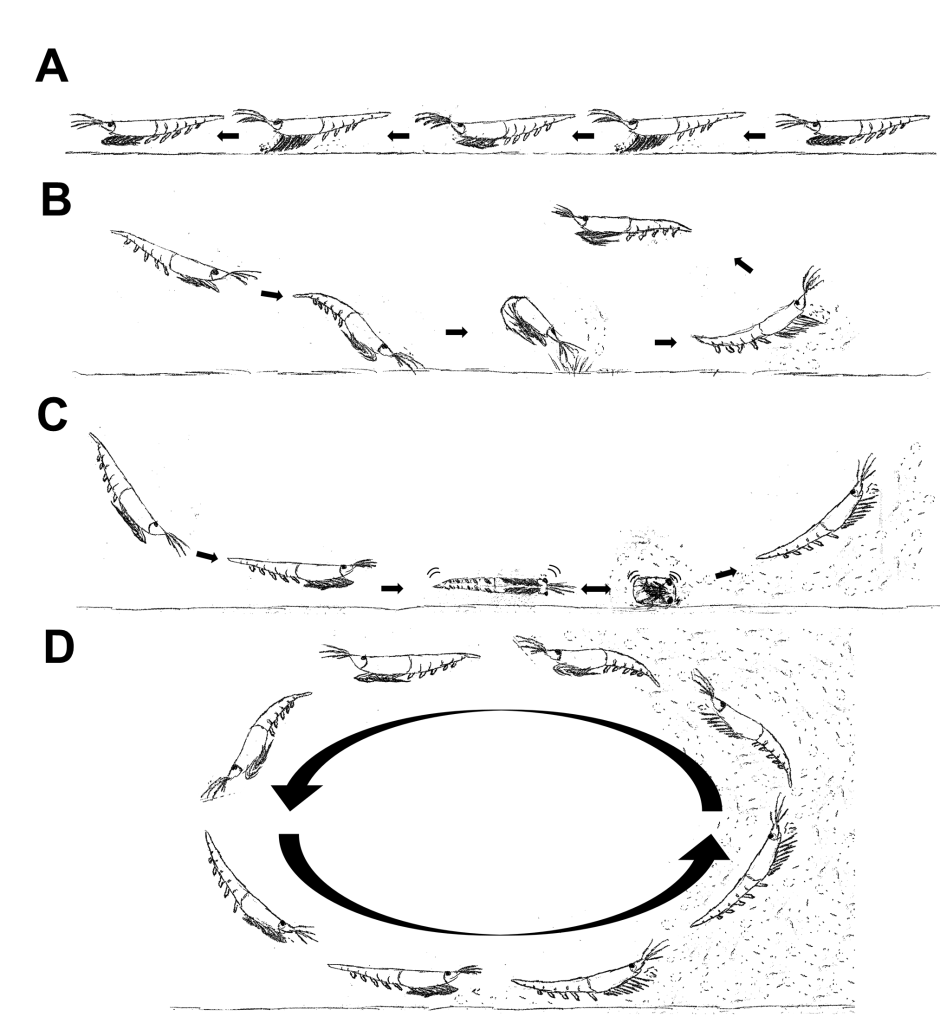
Schematic of krill benthic feeding behaviors. Individuals can (A) “skim” the seabed to collect food; (B) “nose dive” into the sediment and tail-flick backwards to stir up sediment; or (C) “flip” onto their sides and “flop” around on the seabed by undulating their body several times to produce a plume of sediment. (D) Aggregations of krill can work together in a “ball” to stir up sediment into the water column. Individual krill move towards the center of the “ball” at the seabed (right), then upward to feed on the suspended sediment; krill then move towards the outside of the “ball” (left) before moving back down towards the seabed.

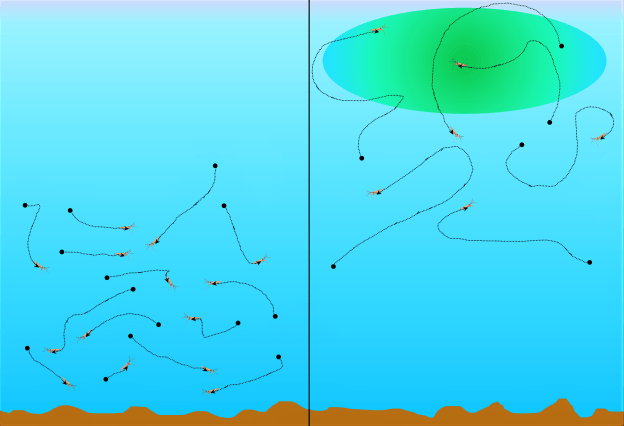
My second paper was published in March 2021 in Current Biology. This paper, titled “Lowered cameras reveal hidden behaviors of Antarctic krill”, talks about a number of things. The main points of this paper are (1) krill use a variety of different behaviors to feed from the benthos, including working together in giant balls; (2) krill are often found solitary or in very low density aggregations; and (3) krill move more quickly when in dense aggregations than solitary.

In general, it has been known for decades that individual krill are capable of feeding on the sediment. However, krill working collectively together to stir up the benthos has not been documented before. Also, this cooperative feeding behavior is incredibly rare for invertebrates. Nevertheless, we observed krill “ball-feeding” a number of times in late autumn. It’s likely that this behavior occurs when krill need to eat, and the only food available to them is carbon in the sediment.

Additionally, the idea of individual krill movement behaviors changing with aggregation density adds to the growing body of literature and observations about organisms in groups. It is also one of the few papers which addresses how the aggregations influence individual behaviors rather than how individuals can influence aggregations.

Studying krill motion in the Southern Ocean

My first paper, published in September 2018 in Limnology and Oceanography, analyzed differences in individual krill movement behaviors and krill vertical distributions in late spring and autumn along the Western Antarctic Peninsula.

There was a difference in their movement behaviors and vertical distributions between the two seasons. There were greater abundances of krill near the surface of the water column in late spring and greater abundances near the sediment in late autumn. Krill also moved faster in late spring and more slowly in autumn.

We also found krill vertical distributions in late autumn were influenced by whether it was night or day. Krill were found deeper during the day and shallower at night.

Krill movement behaviors also showed a diel pattern, although this was not consistent between seasons. In late spring, krill moved more quickly at night and more slowly during the day. In late autumn, krill moved more quickly during the day and more slowly at night.

Combined, the differences in vertical distributions and motility suggest krill were feeding on phytoplankton in late spring and on detritus in the sediment in late autumn.

Here is the URL to access the paper: https://aslopubs.onlinelibrary.wiley.com/doi/abs/10.1002/lno.11024

The Professional Blog of Dr. Mary K. Kane

Hi! My name is Dr. Mary K. Kane.  I am currently a postdoctoral researcher studying dinoflagellate-parasitoid interactions in Mallorca at the Mediterranean Institute for Advanced Studies (IMEDEA). I obtained my Ph.D. in Oceanography in 2019 from the Graduate School of Oceanography at the University of Rhode Island.  My research interests are:

  • Development of novel methods to observe individual phytoplankton and zooplankton in situ and in the laboratory
  • Individual phytoplankton and zooplankton behaviors and physiology
  • Changes in zooplankton and phytoplankton populations, community compositions, and predator-prey interactions under various environmental conditions
  • Distributions and abundances of phytoplankton and zooplankton populations in different regions
  • Micro- to macro-scale biological, biogeochemical, and biophysical interactions
  • Long-term ecological trends

Feel free to contact me at marykatkane@gmail.com